By Adeniran Bamisaye
Some time ago, I walked into the office of then Assistant Inspector-General of Police, Olatunji Rilwan Disu, at the Force Criminal Investigation Department Annex, Alagbon, Lagos. I had gone there for something entirely different, but my attention was drawn to a whiteboard positioned behind his desk.
There was a handwritten message on it:
“If I help you by subverting the law, then I have proven myself unworthy to uphold it. And if I cannot be trusted in my duty, can you truly trust me as a friend?”
I took a picture.
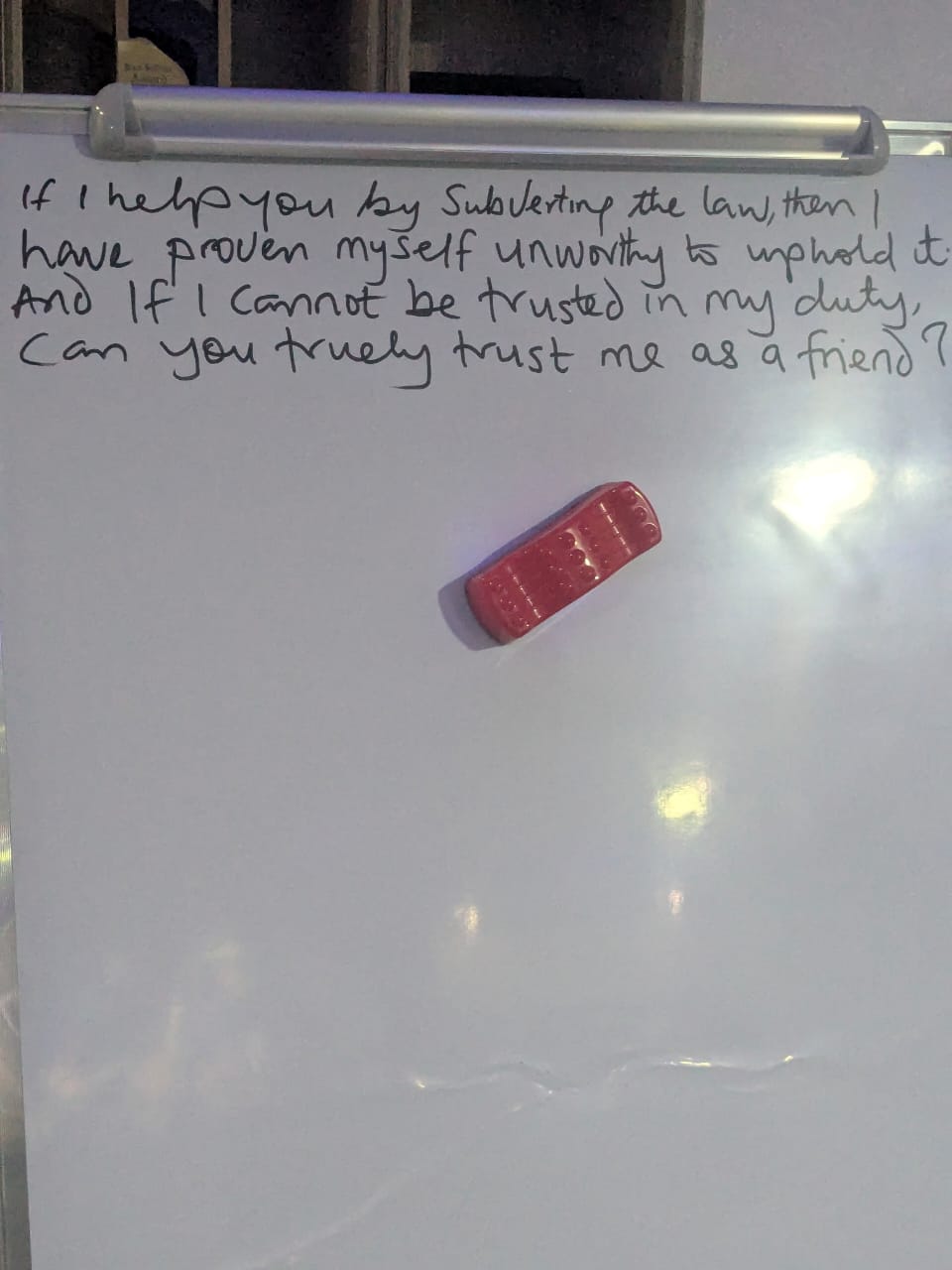
What struck me was not just the message, but its position. The board faced the visitor’s side of the desk. Anyone who came into the office, sat across from him and looked up would eventually encounter those words.
I cannot say whether that was precisely why it was positioned there. But its effect was difficult to miss. Before you could ask for a favour, seek an intervention or suggest that something be “helped” along, you were already staring at a principle that seemed to say: there are things I cannot do for you, even if I know you.
At the time, I did not know that just eight days later, Disu would be appointed Acting Inspector-General of Police. But that coincidence made me return to the words and think about the larger question behind them.
What happens when friendship meets the law?
It is a question worth asking in a country where relationships often influence how we navigate institutions. We ask someone we know to make a call. We ask for an exception. We ask someone to “help us sort it out.” Sometimes, what looks like a harmless favour is actually a request to bypass a rule.
For the ordinary citizen, that may be a moral choice. For someone whose job is to enforce the law, it is a professional test.
And perhaps that is what makes the statement on that board so interesting. It does not say friendship is unimportant. It says friendship cannot be allowed to determine whether the law applies. That distinction matters.
I do not know everything that has happened behind that desk, and I would not pretend that a handwritten statement is enough to tell us everything about the person who wrote it. A principle displayed on a board is not, by itself, proof of character. Character is revealed when the principle becomes inconvenient—when saying no has a cost, when the person making the request is someone you know, or when bending the rule appears easier than enforcing it.
That is why the career behind those words is worth considering, but only in the right proportion.
Disu has spent more than three decades in the Nigeria Police Force, serving in frontline policing, criminal investigation, intelligence and command. He led the Lagos State Rapid Response Squad for several years before becoming head of the Police Intelligence Response Team and later serving as Commissioner of Police in Rivers State and the Federal Capital Territory.
His professional journey does not prove that every decision he has made has been perfect. No serious assessment of any public officer should begin or end there. But there have been moments that make the principle on that board relevant to the public conversation around his leadership.
When Disu assumed duty at Alagbon, he spoke of strengthening the department’s investigative capacity and adopting a zero-tolerance approach to corruption. After becoming Inspector-General, he publicly emphasised professionalism, accountability and respect for human rights, telling senior officers that there would be “no sacred cows.”
Those commitments will ultimately have to be judged by what happens in practice, not by what is written on a board or said at a conference. That is true of Disu, and it is true of every person entrusted with authority.
Because integrity is not simply refusing to do what is wrong when the person involved is a stranger. The harder test comes when the person standing before you is your friend. It comes when it is your relative. It comes when it is someone influential. It comes when refusing the request may cost you a relationship, an opportunity or someone’s goodwill. That is where sentiment can begin to compete with responsibility.
And perhaps we need to rethink what we mean when we say someone is a “good friend.” Is a good friend the person who will always find a way around the rules for you? Or the person who can look you in the eye and say, “I cannot do this for you because it is wrong”?
For those entrusted with enforcing the law, the answer should be obvious.
The lesson also extends beyond policing. Judges, lawyers, soldiers, civil servants, regulators, political office holders and anyone who exercises public authority face the same fundamental test: can personal relationships change the way you apply your responsibility?
Perhaps that is why the whiteboard stayed with me. It was simple. No official seal. No elaborate frame. Just a few handwritten words behind a desk, facing the person sitting across from it.
You could walk into that office as a friend, a colleague, an influential person or a stranger. Before you made your request, you had already been given something to consider.
The law is not something I will bend for you.
That is not necessarily a declaration about one man. It is a standard we should want from anyone entrusted with power. Because when the person enforcing the law can be persuaded to break it for you, you may think you have found a good friend.
But what you may actually have found is someone who cannot be trusted with authority. And perhaps that is the real question the words behind IGP Disu’s desk leave us with:
When friendship asks us to compromise our duty, which one should define who we are?